How To Check Oxygen Levels At Home Safely | BMC Medical
A practical step-by-step guide to How to check oxygen levels at home safely, including preparation, instructions, common issues, tips, and next steps.

How To Check Oxygen Levels At Home Safely
Checking oxygen levels at home with a pulse oximeter is a simple way to monitor how well your lungs are moving oxygen into your blood. It is safe when you use the device correctly, keep your hands warm and still, and know when a reading is low enough to seek medical help. This guide walks you through preparation, a clean six-step measurement routine, common problems like cold fingers or shaky readings, and clear red flags that mean you should call a health professional instead of retesting all day.
Fast Answer
- Sit still for five minutes, warm your hands, remove dark nail polish, rest your arm on a table, then place the sensor on a bare finger and wait for the number to stop changing.
- A single low reading is not an emergency by itself; retest once after warming your hand, and if it stays low or you feel breathless, confused, or have chest pain, contact a health professional right away.
Before You Start
- Wash and dry your hands, then remove any nail polish, artificial nails, or henna from the finger you plan to use, because colored coatings can block the light the sensor needs.
- Sit quietly for at least five minutes with both feet flat on the floor, because recent activity, talking, or laughing can change your breathing and give a misleading number.
- Warm your hands by rubbing them together or holding them under a warm blanket for a few minutes, since cold fingers reduce blood flow and often cause a lower or flickering reading.
- Rest your hand on a table or armrest at about heart level and keep the sensor cable away from pets and small children, so the device stays still and the reading can settle.
Step-by-Step Instructions
Turn on the device and check the display
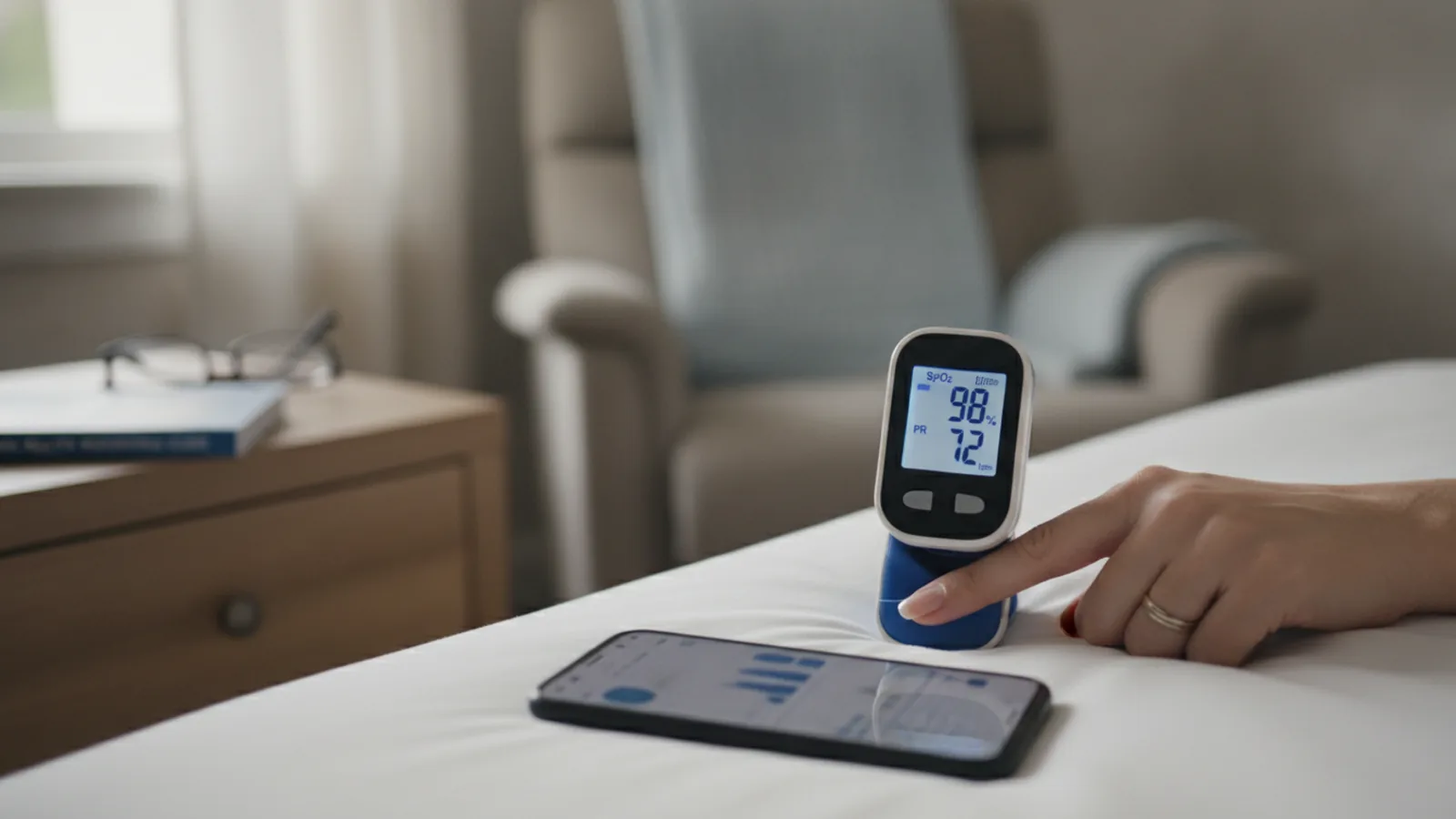
Press the power button and watch the screen light up. You should see a number for oxygen saturation, usually shown as a percentage, and often a pulse rate and a small wave or bar that moves with your heartbeat. Before you put the sensor on your finger, look for a low battery icon or a message that tells you the signal is poor. If the screen stays blank, check that the batteries are in the right way and that the sensor window is clean. This quick check matters because a device that is not ready can show a blank or flashing number that looks like a reading but is not one. Once the screen is steady, you are ready to place the sensor. Keep the device on a flat surface while you get your hand into position, so you do not drop it or press buttons by accident.
Place the sensor on a bare finger
Slide your index or middle finger into the clip until your fingertip touches the end but is not pressed hard against it. The sensor should sit comfortably, not pinch. Your fingernail should face the side with the small light window, and your finger should be free of polish, cream, or dirt. If you have long nails, choose a finger where the nail does not block the light path. Rest your hand palm down on a table or armrest, with your fingers relaxed and slightly apart. This step matters because the device shines light through your finger, and anything that blocks or scatters that light can make the number wrong. Do not use a thumb if you can avoid it, since the thumb often has a strong pulse of its own that can confuse the sensor. Once the sensor is on, keep that hand still and let the other hand rest too.
Stay still and breathe normally
Keep your body relaxed and breathe as you normally would. Do not take deep breaths or hold your breath to try to change the number. Movement, talking, and laughing can all make the reading jump around, so stay quiet for the next minute. If you feel anxious, look at a fixed point on the wall and let your shoulders drop. This matters because the device needs several seconds of steady blood flow to calculate a trustworthy percentage. A moving hand creates shadows and false pulses that the device may read as a low oxygen level. If you must cough or sneeze, wait a few seconds after you finish and then let the reading settle again. Keep your feet flat and your back supported, because a slouched position can make it harder to take full, calm breaths. The goal is a quiet body and a normal breathing pattern.
Wait for the number to stop changing
Watch the oxygen number for at least 30 to 60 seconds. A good reading will hold steady, maybe moving by one point at most. Many devices also show a small wave or a bar that rises and falls with your pulse; when that wave looks even and regular, the number is more likely to be accurate. If the number keeps jumping up and down, or if the wave looks flat or jagged, do not trust that result yet. This check matters because the first few seconds after you place the sensor often show a changing number while the device calibrates. Give it time to settle, and keep your hand still through the whole wait. If the reading is still unstable after a full minute, note that and prepare to retest on another finger. A steady number on a steady wave is your best sign that the device is reading you well.
Record the reading and note how you feel
Write down the oxygen percentage, your pulse rate if shown, the time, and which finger you used. Also write one or two words about how you feel, such as calm, short of breath, or dizzy. If you are checking for a health professional, this simple log helps them see patterns over hours or days instead of one number. This step matters because a single reading is only a snapshot; your symptoms and the trend over time give the number meaning. For example, a reading of 94% while you feel fine and are resting is different from the same number while you are struggling to breathe. Keep your notes in one place, like a small notebook or a note on your phone, so you do not lose them. Do not change any medicine based on a reading alone. If you use the device often, record the time of day too, since oxygen levels can vary slightly with sleep and activity.
Decide what to do next based on the result
If your reading is in the normal range for you and you feel well, you can stop and go about your day. If the number is lower than usual or lower than the range your health professional gave you, first warm your hand, rest for a few minutes, and retest on a different finger. If the retest is still low, or if you have trouble breathing, chest pain, confusion, or blue lips, contact a health professional or emergency services right away. Do not keep retesting over and over in the hope of a better number. This step matters because the action you take matters more than the exact number on the screen. A low reading plus symptoms is a reason to get help, not a reason to wait. If you are unsure, call a nurse line or your doctor's office and describe both the number and how you feel. They can tell you whether to monitor at home or come in.
Quick Reference
| Situation | Action | Why it helps |
|---|---|---|
| Your reading is lower than usual but you feel fine and can breathe easily. | Warm your hands, sit quietly for five minutes, then retest on a different bare finger and write down both numbers and the time. | Cold hands and a single odd reading are common causes of a falsely low result, so a calm retest gives a clearer picture before you worry. |
| Your reading stays low after a retest, or you feel short of breath, dizzy, or confused. | Stop retesting, sit upright, and contact a health professional or emergency services, describing your reading, your symptoms, and when they started. | A low oxygen level combined with symptoms can mean your body needs help quickly, and waiting to see if it improves on its own can delay care. |
| The number jumps around or the device shows a weak signal message. | Keep your hand still, remove any nail polish or false nails, warm your fingers, and try a different finger after a short rest. | A moving hand or blocked light path makes the device guess, and a steady signal is required before any number can be trusted. |
Common Issues
- The reading is lower than expected and your fingers feel cold.: Rub your hands together for a minute, wrap them in a warm cloth, or run warm water over them and dry them well, then wait five minutes and retest on a bare finger. Cold skin narrows blood vessels near the surface, which can reduce the signal the device receives and make the oxygen number look lower than it really is.
- The number keeps changing and never settles on one value.: Place your hand flat on a table or armrest, relax your fingers, and stay quiet and still for a full minute. Remove anything that could block the light, such as dark polish, a bandage, or a tight ring, and try a different finger. Movement and poor contact are the most common reasons a device cannot calculate a steady percentage.
- The device will not turn on or the screen stays blank.: Check that the batteries are inserted in the correct direction and are not worn out, and clean the sensor window with a soft dry cloth. If your device uses a charging cable, make sure it is fully seated and try a different outlet. If it still does not turn on, use a backup device if you have one, or contact the place where you got it for help.
Advanced Tips
- Check your device against a known good reading when you are well, so you learn your normal range and can spot a real change later.
- Keep a simple log with time, finger used, oxygen number, pulse, and one word about how you feel, because patterns over days are more useful than one reading.
- If you use the device often, ask your health professional what range is normal for you and what number should prompt a call, then write that rule where you can see it.
- Avoid checking right after coffee, a hot shower, or exercise, because those can change your pulse and breathing for a short time and make the number harder to compare.
Final Checklist
- Hands are washed, warm, and free of nail polish, false nails, cream, or dirt on the finger you will use.
- You have sat quietly for at least five minutes with your feet flat and your back supported.
- The sensor is on a bare finger, your hand rests at heart level on a table or armrest, and you are staying still.
- You have waited for the number and the pulse wave to settle, written down the result, and noted how you feel.
FAQ
What is a normal oxygen level at home?
For most healthy adults at sea level, a resting oxygen saturation of about 95% to 100% is common, but your normal range can be different if you have a lung or heart condition. Ask your health professional what range is right for you, because a number that is fine for one person may be low for another. Always compare the reading with how you feel and with your usual baseline.
Can I trust a home pulse oximeter?
A home pulse oximeter can give a useful estimate when you use it correctly, but it is a screening tool, not a diagnosis. Cold hands, dark nail polish, movement, and poor circulation can make the number less accurate. Use a steady signal, retest when a reading seems odd, and let your symptoms and a health professional guide any decision about care.
What should I do if my reading is low but I feel fine?
Warm your hands, sit quietly for five minutes, and retest on a different bare finger. If the reading is still low, contact a health professional and describe the number, your symptoms, and when they started. Do not assume you are safe just because you feel okay, and do not keep retesting for a better number instead of getting advice.