Walking Stick vs Rollator: Which Should You Choose? | BMC Medical
A practical head-to-head comparison of Walking Stick and Rollator, covering quick verdict, key differences, category winners, buyer fit, and FAQ.
Walking Stick vs Rollator: Which Should You Choose?
Head-to-head comparison
Overall winner: Rollator for its superior stability, integrated seating, and capacity for significant weight support.
A rollator is the clear choice for individuals requiring substantial balance support, frequent rests, and help with endurance during walks. A walking stick is better suited for those who need minimal, light support to assist with balance or to alleviate pressure on a single leg, particularly where portability and use in tight spaces are paramount.
Option A
Walking Stick
- Best fit: Minor balance issues or single-leg support.
- Strength: Unmatched portability and simplicity.
- Tradeoff: Offers minimal weight support.
Option B
Rollator
- Best fit: Significant balance or stamina challenges.
- Strength: High stability with a built-in seat.
- Tradeoff: Larger size and weight reduce portability.
Head-to-Head Scorecard
Walking Stick vs Rollator: Key Differences
Choosing a mobility aid is a significant decision that directly impacts independence and safety. While both walking sticks and rollators are designed to assist with mobility, they serve fundamentally different needs and user profiles. The choice is not about which is "better" overall, but which is clinically appropriate for an individual's specific physical requirements.
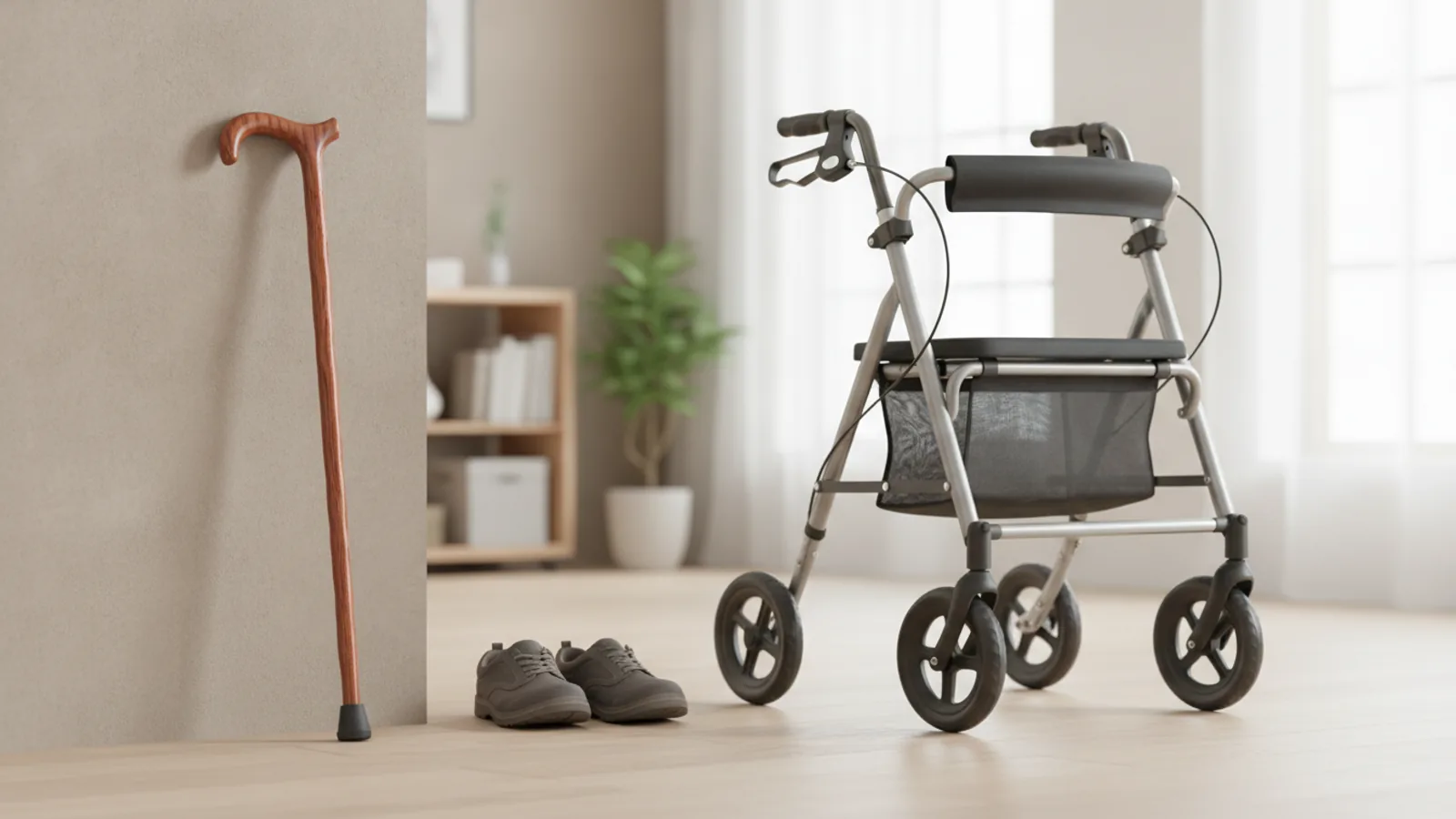
A walking stick (or cane) is a single-point aid designed to provide modest balance support and relieve some pressure from one leg. It acts as an extension of the arm, widening the user's base of support slightly. It is best for individuals who are generally stable on their feet but may experience mild dizziness, minor joint pain, or weakness in one leg. Its primary advantages are its simplicity, light weight, and portability.
A rollator, by contrast, is a multi-point walking frame with three or four wheels, handlebars, and hand-operated brakes. It is engineered for individuals who require substantial, continuous support due to significant balance problems, generalised weakness, or low stamina. Unlike a walking stick, a rollator can bear a significant portion of the user's weight. Most models include a built-in seat and a basket, allowing users to rest safely and carry personal items, thereby greatly enhancing their endurance and range of activity.
The core distinction lies in the level of support provided. A walking stick assists, while a rollator supports. This article will deconstruct these differences across several key criteria to help you, in consultation with a healthcare professional, determine the most suitable option.
Measurement
Stability & Weight Support
The primary function of any mobility aid is to provide a stable base of support to prevent falls. In this regard, the structural differences between a walking stick and a rollator lead to a vast disparity in performance. A walking stick offers a single point of contact with the ground. While this widens the user's effective base of support, it is a minimal addition. It can help a user correct minor imbalances but cannot prevent a fall if their centre of gravity shifts significantly.
Furthermore, a walking stick is not designed to bear a large amount of weight. A user should not place their full body weight through the stick; doing so can cause it to slip or break, and may place undue stress on the wrist and shoulder. It is intended to provide sensory feedback and light support, offloading approximately 25% of a person's weight from one leg when used correctly.
A rollator, with its three or four-wheeled frame, provides a much larger and more stable base of support that surrounds the user. This configuration significantly reduces the risk of tipping in any direction. The user walks "within" the frame, keeping their centre of gravity securely inside the base. The wheels allow for a smooth, continuous gait without the need to lift and place the aid with each step, which itself can be a moment of instability. Critically, a rollator is designed for weight-bearing. Users can safely lean on the frame, transferring a significant portion of their body weight through their arms to the device, which is essential for those with lower body weakness or pain.
Measurement
Portability & Transport
How easily a mobility aid can be transported and stored is a crucial factor for daily life, affecting everything from visiting friends to attending appointments. A walking stick is the undisputed champion of portability. Most are incredibly lightweight, often weighing less than 500 grams. Many models are foldable, collapsing into several sections that can easily fit into a handbag, a large pocket, or the glove box of a car. When not in use, a standard stick can be hooked over an arm or leaned against a chair without being obtrusive.
Rollators, by nature of their robust, supportive design, are larger and heavier. While most are designed to fold for transport, the process is more involved. Even when folded, a rollator remains a bulky item. Lifting it into the boot of a car requires a degree of strength and can be challenging for some users or their carers. Navigating public transport, such as buses or trains, with a rollator can be difficult due to its width and the space it occupies. While lighter "travel" models exist, they still cannot compete with the sheer convenience and minimal footprint of a simple walking stick.
Measurement
Manoeuvrability & Indoor Use
Navigating the home environment or crowded public spaces presents unique challenges. The slim profile of a walking stick gives it a significant advantage in tight quarters. It can be used to navigate narrow hallways, cluttered rooms, and small bathrooms with ease. Its single point of contact allows the user to pivot and turn on the spot without needing a large turning radius. In a busy shop or café, a walking stick is discreet and does not obstruct pathways for others.
A rollator requires more space to manoeuvre. Its width can make it difficult to pass through standard interior doorways, especially in older homes. Turning a rollator around requires a clear area, which may not be available in a confined space like a kitchen or bedroom. While three-wheeled models offer a tighter turning circle than their four-wheeled counterparts, they still present a much larger footprint than a stick. This can lead to frustration and may even result in users abandoning the aid indoors, negating its safety benefits. For primarily indoor use in a compact living space, a walking stick—or a non-wheeled walking frame (Zimmer frame)—is often more practical.
Measurement
Endurance & Stamina Support
For many individuals, the primary barrier to mobility is not balance but stamina. Conditions such as COPD, heart failure, or general frailty can cause fatigue and breathlessness after only a short period of walking. This is an area where the rollator provides a transformative benefit that a walking stick cannot match. The integrated seat, a standard feature on most four-wheeled rollators, is a game-changer for endurance.
It allows the user to take a rest break at any time, in any place, without needing to search for a public bench. This sense of security encourages longer walks and greater participation in activities outside the home, whether it's a trip to the shops or a walk in the park. The user can walk until they feel tired, lock the brakes, sit down for a few minutes to recover, and then continue on their way. A walking stick offers no such feature. A user who becomes tired or breathless must find an external place to sit, which may not always be available, potentially leading to anxiety and shorter, less ambitious outings.
Measurement
Simplicity & Learning Curve
The ease with which a user can adapt to a new mobility aid is an important consideration. A walking stick is an incredibly intuitive device. Aside from ensuring it is adjusted to the correct height (the handle should be level with the user's wrist crease when their arm is hanging loosely by their side), there is very little to learn. The user holds it on the opposite side to their weaker leg and moves it forward in time with that leg. There are no moving parts, brakes, or folding mechanisms to master.
A rollator, while not overly complex, does have a steeper learning curve. The user must learn how to operate the brakes, both for slowing down (squeeze) and for parking (push down to lock). They must remember to always lock the brakes before attempting to sit down. Folding and unfolding the device can also require practice. There is also a risk of the rollator "running away" from the user, particularly on downward slopes, if they push it too far ahead of them instead of walking within the frame. This requires a period of adjustment and instruction, ideally from a physiotherapist, to ensure safe and effective use.
Measurement
Cost & Affordability
The financial aspect of purchasing a mobility aid is a practical concern for many. There is a substantial price difference between a walking stick and a rollator. Basic, functional walking sticks are widely available at a very low cost. Even more advanced models with ergonomic handles, specialised ferrules (tips), or lightweight carbon fibre construction remain relatively affordable for most people.
Rollators represent a more significant financial investment. As complex pieces of equipment with wheels, brakes, and folding mechanisms, their manufacturing costs are much higher. Prices can vary considerably based on materials (steel vs. lightweight aluminium), wheel size, and additional features like suspension or more advanced braking systems. While they offer far greater functionality, their initial purchase price can be a barrier for some. It is important to weigh the cost against the significant safety and independence benefits a rollator can provide for the right user.
Choose a Walking Stick If:
- You need only minor balance support. If you are generally steady but occasionally feel a slight wobble, a stick can provide the extra point of contact you need.
- You need to reduce the load on one leg. For conditions like mild hip or knee arthritis, a stick can effectively offload some weight and reduce pain.
- Portability is your highest priority. If you need an aid that is easy to take in the car, on public transport, or store away when not in use, a stick is the ideal choice.
- You frequently navigate tight, indoor spaces. A stick is far easier to use in a small flat, narrow hallways, or crowded shops.
- Your upper body and grip strength are good. Using a stick effectively requires the ability to securely grip the handle and support it with your arm and shoulder.
Choose a Rollator If:
- You have significant balance issues. If you feel unsteady much of the time or have a history of falls, the wide, stable base of a rollator is necessary for safety.
- You have weakness in both legs or generalised weakness. A rollator allows you to support a large portion of your body weight through your arms, compensating for lower body weakness.
- You suffer from low stamina or get breathless easily. The built-in seat is an essential feature that allows you to manage your energy and extend the duration of your outings.
- You need to carry items with you. The basket or bag is invaluable for carrying shopping, a handbag, or an oxygen cylinder, leaving your hands free to safely control the rollator.
- You do not need to navigate very tight spaces or frequently lift the aid into a vehicle by yourself. The rollator's size is its main drawback, so it is best suited for those with adequate space at home and who have assistance if needed for transport.
Final Verdict: Walking Stick vs Rollator
The decision between a walking stick and a rollator hinges entirely on an honest assessment of your individual mobility needs. This is not a choice of preference, but one of clinical suitability and safety. Our analysis concludes that the Rollator is the overall winner in terms of the sheer scope of support and safety it provides for those with moderate to significant mobility challenges.
The rollator's four-point base, weight-bearing capacity, and integrated seat address the most critical barriers to safe mobility: poor balance and low stamina. For someone at risk of falls or whose world is shrinking due to fatigue, a rollator can be a liberating tool that restores independence and confidence. It allows for greater participation in community life, which is crucial for both physical and mental well-being.
However, this does not diminish the value of the Walking Stick. For its intended user—someone with minimal support needs—it is the perfect tool. It is discreet, inexpensive, and exceptionally portable. To give a rollator to someone who only needs a walking stick would be to encumber them unnecessarily. Conversely, to give a walking stick to someone who requires the support of a rollator is to create a significant and unacceptable safety risk.
Crucially, this decision should be made in consultation with a medical professional, such as your GP or a physiotherapist. They can perform a comprehensive assessment of your gait, balance, strength, and overall health to provide a formal recommendation for the safest and most effective mobility aid for you.
Walking Stick vs Rollator: Which Should You Choose? FAQ
Can I use a walking stick if I have balance problems in both legs?
A single walking stick is generally not recommended for individuals with bilateral (both sides) weakness or significant balance deficits. A stick is designed to provide support on one side. If you are unstable on both sides, a single point of support is often insufficient to prevent a fall. In this scenario, a rollator or a walking frame (Zimmer frame) provides a much safer, more stable base of support. A physiotherapist may sometimes recommend using two walking sticks, but this requires a specific gait pattern and coordination that is not suitable for everyone.
How do I know if my walking stick or rollator is the correct height?
Correct height adjustment is critical for both safety and posture. To check the height for either a walking stick or a rollator, stand upright in your usual shoes with your arms hanging loosely at your sides. The handgrip should be level with the crease of your wrist. When you place your hand on the grip, your elbow should have a slight, comfortable bend of about 20-30 degrees. If the aid is too high, it will force you to hunch your shoulders; if it is too low, it will cause you to stoop, both of which can lead to back and shoulder pain.
Are 3-wheel rollators better than 4-wheel rollators?
Three-wheel and four-wheel rollators serve slightly different purposes. A 3-wheel rollator is more manoeuvrable and has a tighter turning circle, making it better for indoor use and navigating smaller spaces. However, it is less stable than a 4-wheel model and typically does not have a seat. A 4-wheel rollator provides the highest level of stability and almost always includes a seat, making it the superior choice for outdoor use, longer distances, and for users who need to rest frequently. For most people requiring the support of a rollator, the 4-wheel design offers greater safety and functionality.
Is there a risk of becoming dependent on a mobility aid?
This is a common concern. The goal of a mobility aid is to enable safe and confident movement, not to create dependency. Using the correct aid can actually improve strength and stamina by allowing you to walk more often and for longer distances than you could without it. This can prevent the muscle deconditioning that comes from inactivity. A physiotherapist can prescribe exercises to maintain and improve your strength and balance, ensuring the aid is a tool for enablement, not a crutch that leads to decline. It is far riskier to avoid using a necessary aid and suffer a fall, which can lead to serious injury and a profound loss of independence.